Cubic Feet Calculator
A cubic foot (ft³) is a unit of volume equal to a cube measuring 1 foot on each side — about the size of a large milk crate. Enter length, width, and depth in feet, inches, centimeters, or yards to calculate cubic feet, convert to cubic yards, and estimate bags of mulch, topsoil, gravel, or sand instantly.


- Expert Reviewed
- Updated May 2026
- Sources Cited
- No Login Required
- Free to Use
Longest side
Shorter side
Thickness or height
Volume
8.00 ft³
Cubic yards
0.296yd³
Cubic inches
13,824in³
Cubic meters
0.2265m³
US gallons
59.8gal
Translate to Material — How Many Bags or Yards?
Bags needed
4× 2 cu ft
Bulk order
0.30cubic yards
At standard depth
3 in(typical)
Most retail mulch ships in 2-cu-ft bags. 13.5 bags equal one cubic yard of bulk delivery.
How to Use This Calculator
Enter the length, width, and depth of your space — in feet, inches, centimeters, or yards — and the calculator instantly returns cubic feet, cubic yards, and the number of retail bags needed for your chosen material. No conversion math required.
- Enter dimensionsType your length, width, and depth. Switch units per field — mix feet and inches if needed. The calculator normalises everything to feet before computing.
- Choose a shapeSelect Box (default) for rectangular spaces like garden beds, patios, or slabs. Switch to Cylinder for round planters, columns, or wells — enter diameter and height.
- Read your resultsThe result panel shows cubic feet, cubic yards, and the bag count for your chosen material (mulch, topsoil, gravel, sand, or concrete). Use the material bridge to skip manual division.
What Is a Cubic Foot?
A cubic foot (ft³) is a unit of volume equal to the space occupied by a cube measuring one foot on each side. One cubic foot equals 1,728 cubic inches or 0.037 cubic yards. It is the standard unit for ordering landscaping materials such as mulch, topsoil, and gravel in residential quantities.
The cubic foot belongs to the US customary system. The cubic foot entry on Wikipedia summarizes its history; the formal unit definition appears in NIST Special Publication 811, the federal reference for unit conversion in the United States.
Cubic foot vs. square foot — the key difference
A square foot (ft²) measures area in two dimensions: length × width. A cubic foot (ft³) measures volume in three dimensions: length × width × depth. A 10 × 10 ft patio covers 100 square feet of surface area. The same patio poured 4 inches thick contains 33 cubic feet of concrete. Square feet describe the footprint; cubic feet describe what fills the space above it.
How big is a cubic foot? (visual reference)
The 1-ft cube — your mental anchor
One cubic foot is roughly the volume of a large milk crate, a basketball with room around it, or two standard bags of retail mulch combined. Picturing the cube before you calculate prevents the most common ordering mistake: confusing a 1-cu-ft potting-soil bag with the 2-cu-ft mulch bag stacked next to it.
How to Calculate Cubic Feet
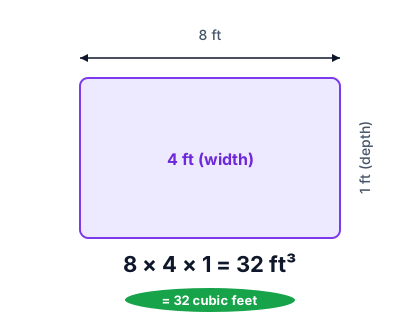
To calculate cubic feet, measure the length, width, and depth of the space in feet, then multiply: V (ft³) = Length × Width × Depth. A garden bed that is 8 ft long, 4 ft wide, and 0.25 ft (3 inches) deep contains 8 cubic feet.
Cubic feet formula
Step-by-step worked example — raised garden bed
A practitioner-tested example from Rachel Torres, M.Ed. — the math program she teaches uses the same raised-bed numbers because the inch-to-foot conversion catches almost every first-year apprentice.
From the classroom
“Half the apprentices I teach forget the inch-to-foot step on raised beds. They measure 12 inches deep, type 12 into the depth field, and order 384 cubic feet of topsoil instead of 32. Convert depth to feet first — every time.”
How to Calculate Cubic Feet From Inches
To calculate cubic feet from inch measurements, either divide each dimension by 12 before multiplying, or multiply all three inch values together and divide the result by 1,728. For a box measuring 24 in × 18 in × 12 in: (24 × 18 × 12) ÷ 1,728 = 3 cubic feet.
Method 1 — Convert each dimension to feet first
Divide each inch value by 12, then multiply the three feet values together.
18 in ÷ 12 = 1.5 ft
12 in ÷ 12 = 1 ft
2 × 1.5 × 1 = 3 ft³
Method 2 — Multiply in inches, divide by 1,728
1,728 = 12³ (one cubic foot in cubic inches). Multiply first, then divide.
5,184 ÷ 1,728 = 3 ft³
How to Calculate Cubic Feet From Other Units
Construction projects mix unit systems often — a tape measure reads in inches and feet, a soil-bag label reads in cubic feet, and a metric supplier may quote centimeters. The same formula applies; only the unit conversion changes.
From centimeters
× 0.000035315 per cm³
Multiply L × W × D in cm, then × 0.000035315. Or: divide each cm value by 30.48 to get feet, then multiply.
100 × 50 × 20 cm = 100,000 cm³ × 0.000035315 = 3.53 ft³
From yards
× 27 per yd³
Multiply L × W × D in yards, then × 27. Or: multiply each yard value by 3 to get feet, then multiply.
2 × 1 × 0.5 yd = 1 yd³ × 27 = 27 ft³
From square feet × depth
ft² × depth (ft)
If you already know area in square feet, multiply by depth in feet to get cubic feet.
120 sq ft × 0.333 ft (4 in) = 40 ft³
Mixing units within one calculation is the single biggest source of error on residential projects. Convert everything to feet first, write the conversion down, then multiply. The calculator above accepts each dimension in its own unit so the conversion happens automatically.
If your supplier quoted the project in cubic yards, the Cubic Yards Calculator converts your dimensions to cubic yards directly without an intermediate step.
Cubic Feet for Construction Materials
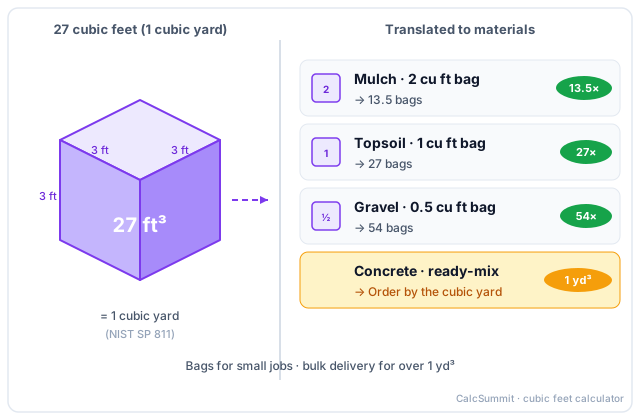
Cubic feet is the starting point for estimating construction materials. Once you know the volume in cubic feet, divide by 27 to get cubic yards for bulk orders, or divide by the bag size (typically 2 cu ft for mulch) to find the number of retail bags needed.
Standard depth by material — coverage benchmarks
| Material | Typical depth | Depth in feet | Coverage per cu ft |
|---|---|---|---|
| Mulch (landscape topdress) | 2–3 in | 0.167–0.25 ft | 4–6 sq ft per cu ft |
| Mulch (garden bed) | 3–4 in | 0.25–0.333 ft | 3–4 sq ft per cu ft |
| Topsoil (lawn repair) | 1–2 in | 0.083–0.167 ft | 6–12 sq ft per cu ft |
| Topsoil (new garden bed) | 6–12 in | 0.5–1.0 ft | 1–2 sq ft per cu ft |
| Gravel (path or patio) | 2–4 in | 0.167–0.333 ft | 3–6 sq ft per cu ft |
| Concrete (residential slab) | 4 in (IRC) | 0.333 ft | Volume — see formula |
| Sand (under pavers) | 1 in | 0.083 ft | 12 sq ft per cu ft |
Concrete slab thickness reflects the IRC 2021 residential standard for slabs on grade.
Retail bag sizes — bags per cubic yard, bags per 10 cu ft
| Material | Bag size | Bags per yd³ | Bags per 10 ft³ |
|---|---|---|---|
| Mulch | 2 cu ft | 13.5 bags | 5 bags |
| Topsoil | 0.75 cu ft | 36 bags | 13.3 bags |
| Topsoil | 1.5 cu ft | 18 bags | 6.7 bags |
| Potting soil | 1 cu ft | 27 bags | 10 bags |
| Gravel (pea) | 0.5 cu ft | 54 bags | 20 bags |
| Sand | 0.5 cu ft | 54 bags | 20 bags |
Mulch and topsoil — bags or bulk?
For mulch-specific projects, the Mulch Calculator handles coverage-depth presets and tells you how many bags to order based on square footage and depth. The general rule: under 5 cubic feet, bags are convenient; from 5 to 27 cubic feet, the per-bag price climbs against bulk; above one cubic yard (27 ft³), bulk delivery is the lower per-cubic-foot cost.
Concrete slabs — from cubic feet to cubic yards
Concrete is sold by the cubic yard, so once you have your cubic feet result, divide by 27 to convert to yards and check it against standard ready-mix batch sizes. A 10 × 10 patio at 4 inches thick = 33 ft³ = 1.22 yd³.
On the jobsite — concrete ordering
“Order the next quarter-yard above your calculated number for any slab pour. Ready-mix trucks dispense in increments, and a short pour costs less than a cold joint from running out at the form line. For a 1.22-yard calculation, order 1.5 yards.”
Gravel, sand, and fill dirt
Aggregate materials follow the same path: calculate in cubic feet, convert to cubic yards by dividing by 27, then add 10–15% for compaction loss. The Gravel Calculator applies the compaction factor automatically and converts to tons using ASTM C33 density values.
Cubic Feet of a Cylinder
The volume of a cylinder in cubic feet equals π × r² × h, with the radius and height in feet. Round planters, sonotube footings, and silo-shaped storage all use this formula. Switch the calculator to the Cylinder tab to compute it directly.
Cylinder formula
Worked example — round planter, 18 in diameter
Cubic Feet Conversion Table
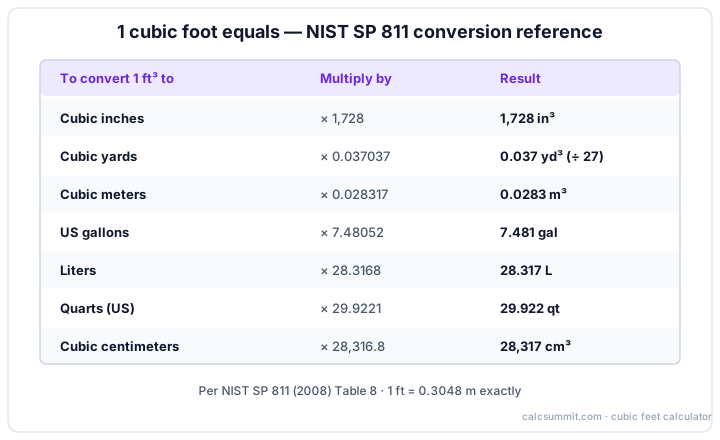
Every conversion factor needed to translate a cubic feet result into another volume unit. Use the table for back-of-envelope checks against the calculator output, or when a supplier quotes the project in metric.
| To convert 1 ft³ to | Multiply by | Result |
|---|---|---|
| Cubic inches | × 1,728 | 1,728 in³ |
| Cubic yards | × 0.037037 | 0.037 yd³ (÷ 27) |
| Cubic meters | × 0.028317 | 0.0283 m³ |
| US gallons | × 7.48052 | 7.481 gal |
| Liters | × 28.3168 | 28.317 L |
| Quarts (US) | × 29.9221 | 29.922 qt |
| Cubic centimeters | × 28,316.8 | 28,317 cm³ |
Values rounded to four significant figures. NIST SP 811 lists the full-precision factors.
If your project is quoted in cubic yards rather than cubic feet, the Cubic Yards Calculator converts your dimensions directly without an intermediate step.
When to Use Cubic Feet vs. Cubic Yards vs. Cubic Inches
Picking the right unit before you start the calculation prevents a second pass at the supplier. The decision turns on what you are buying: small parts and planters work in cubic inches, retail-bagged landscape material works in cubic feet, and bulk-delivered material works in cubic yards.
| Unit | Best for | Construction example |
|---|---|---|
| Cubic inches (in³) | Small parts, planters under 1 ft³ | Round planter 18 in dia × 16 in tall |
| Cubic feet (ft³) | Bagged retail material, small batches | 12 sq ft garden bed at 4-in mulch depth |
| Cubic yards (yd³) | Bulk delivery, ready-mix concrete | 10 × 10 patio at 4-in concrete thickness |
Expert Methodology, Reviewer, and Sources

Reviews: conversion calculators · 22 calculators reviewed
Rachel Torres is a construction education specialist holding an M.Ed. and NCCER Master Trainer certification (#MT-2018-4492). With 14 years bridging field engineering at Kiewit Infrastructure and classroom instruction, she writes CalcSummit's conversion calculators, educational guides, and glossary content to NCCER and ICC curriculum standards. She developed the 'Construction Math Made Simple' course used by ACTE member programs.
Full profile →Standards and sources cited on this page
Last reviewed: by Rachel Torres, M.Ed. · Engineering verification by Alex Rivera, PE · Next scheduled review: May 2027.
This calculator is an educational tool. Verify all measurements before purchasing materials.
Frequently Asked Questions
Six high-frequency People Also Ask questions for cubic feet, answered in the exact phrasing users search.
What to Calculate Next
Cubic feet is the bridge unit. From here, the next calculation depends on what you are ordering — bulk delivery, bagged retail, or a specific material.
Cubic Yards Calculator →
Convert cubic feet to cubic yards for ready-mix concrete, bulk gravel, and dump-truck deliveries.
Feet & Inches Calculator →
Add, subtract, and convert feet-and-inches measurements before plugging into the volume formula.
Mulch Calculator →
Bed-area inputs with depth presets, returning bag counts and bulk cubic yards for landscape mulch.
Gravel Calculator →
Aggregate volume with compaction factor and tonnage output for driveway and path projects.
Sand Calculator →
Sand volume in cubic feet and cubic yards, with paver-base and play-sand presets.
All Conversion Calculators →
Browse the full conversion silo — feet-to-inches, square feet to square yards, board feet, and more.