Square Footage Calculator
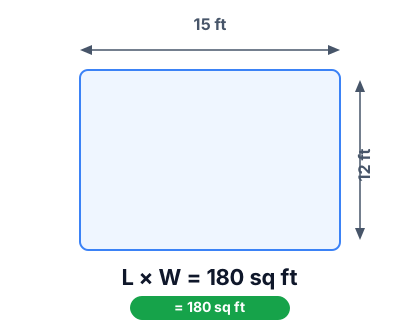
To calculate square footage, multiply length (ft) by width (ft). A 12×15 room equals 180 square feet. For irregular rooms, divide them into rectangles, compute each, and add the results. Use the calculator above to get an instant result in square feet, square yards, square meters, and acres.


- Expert Reviewed
- Updated April 2026
- Sources Cited
- No Login Required
- Free to Use
Raw square footage
168 sq ft
Order this much
168 sq ft
Conversions
18.67
sq yd
15.61
m²
0.0039
acres
Multi-Room Batching
Add every room, get a single whole-house total for HVAC and suppliers.
Per-Material Waste
Paint, flooring, tile, carpet, drywall — each with cited waste factors.
ANSI Z765-2020 Mode
Appraiser-grade gross living area for Fannie Mae and Freddie Mac reports.
How to Calculate Square Footage
To calculate square footage, multiply length in feet by width in feet. For a 12 ft × 14 ft living room, square footage is 12 × 14 = 168 sq ft. Convert inch measurements to feet by dividing by 12 before multiplying. For circles, use π × r²; for triangles, use ½ × base × height. Add or subtract shape areas to handle irregular rooms and cut-outs.
The Square Footage Formula
Square footage is the two-dimensional area of a surface expressed in square feet. One square foot equals a square measuring 1 ft × 1 ft, which contains 144 square inches or 0.0929 square meters. The unit is defined by NIST SP 811 (2008 edition, Table 8) and is the base measurement every US supplier, appraiser, and building inspector works in.
Worked Example — 12 × 14 Living Room
A rectangular living room measures 12 ft × 14 ft:
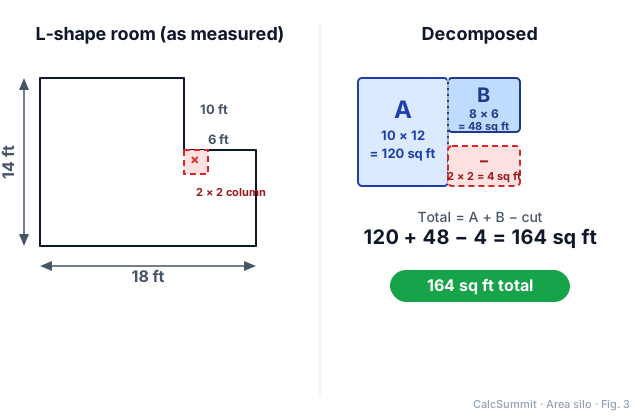
Worked Example — L-Shaped Room with a Column Cut-Out (IG-4)
Irregular rooms look intimidating but break down into simple shapes. An L-shaped great room with a 2 ft × 2 ft structural column is two rectangles minus one square.
For volume-based materials (concrete, gravel, topsoil), use the cubic yards calculator — it takes square footage × depth and returns cubic yards with material density built in.
How to Measure a Room Accurately
Measure every room twice, record to the nearest inch, and always sketch the floor plan before reaching for the tape. A steel tape measure reads to 1/16 in; a laser distance meter reads to 1/8 in at 50 ft. Both are acceptable for material ordering. Measure at baseboard height — not at a corner stuffed with furniture.
The Five-Step Room Measurement Checklist
- Sketch first. Draw the room from overhead. Mark doorways, closets, columns, and fixtures. Every bump-out gets its own rectangle.
- Measure long wall to long wall. Tape stretched wall-to-wall, not baseboard-to-baseboard. Subtract 1/2 in on each end for crown molding overhang.
- Record in inches, convert to feet. 153 in ÷ 12 = 12.75 ft. Keep the decimal — do not round down to 12 ft or you short the room by 9 in.
- Capture height when paint or wall-covering is in scope. Ceiling-to-floor height × room perimeter = wall area. Subtract door (21 sq ft each) and window (15 sq ft each) openings.
- Double-check with a diagonal. In a rectangle, diagonal = √(L² + W²). If the measured diagonal does not match, the room is out of square and you need two triangles, not one rectangle.
Tool tip from a practitioner: A Bosch GLM 50 or Leica Disto D2 laser meter pays for itself on the first multi-room job. Tape a small mirror to the far wall for closet measurements where the laser cannot bounce straight off paint.
“On a production remodel, we measured every room twice before ordering flooring. The second measure caught a 0.5 ft error in the master bath that would have cost us one extra box of tile at $85. Multiply that by 40 rooms on a small multifamily and measurement discipline starts paying the crew's lunch.”
Formulas for Every Room Shape
The seven shapes below cover roughly 98% of residential and light-commercial rooms. Pick the matching formula, plug in the dimensions in feet, and read the area in square feet. For any room that doesn’t fit one of these, decompose it into two or more of these shapes and add or subtract their areas.
| Shape | Formula | Inputs | Worked Example |
|---|---|---|---|
| Rectangle / Square | A = L × W | Length, Width (ft) | 12 × 14 = 168 sq ft |
| Right Triangle | A = ½ × b × h | Base, Height (ft) | 10 × 8 ÷ 2 = 40 sq ft |
| Circle | A = π × r² | Radius (ft) | π × 6² ≈ 113.1 sq ft |
| Half-Circle | A = (π × r²) ÷ 2 | Radius (ft) | (π × 4²) ÷ 2 ≈ 25.1 sq ft |
| Trapezoid | A = ½ × (a + b) × h | Parallel sides a, b; height (ft) | ½ × (10 + 14) × 8 = 96 sq ft |
| L-Shape (two rects) | A = (L₁ × W₁) + (L₂ × W₂) | Both rectangle dimensions | (10 × 12) + (6 × 8) = 168 sq ft |
| Irregular (with cut-out) | A = Σ rects − cut-outs | All shapes; subtract openings | 168 − (2 × 2) = 164 sq ft |
π = 3.14159. For a half-circle (bay window, curved alcove), divide the full circle area by 2.
Multi-Room Batching — Add Every Room into One Total
HVAC quotes, flooring orders, and whole-house paint counts all need a single square-footage number — not a dozen room notes. The multi-room batching mode adds every room into one running total and one material plan. Zero other square footage calculators on the SERP support this pattern, which is the primary reason this tool exists.
Three-Room Worked Example
When Batching Saves the Most Time
- Whole-house paint orders (every room, one gallon count).
- HVAC Manual J load calculations (cooling and heating per total conditioned sq ft).
- Flooring replacements in three or more rooms (carpet roll yardage adds up fast).
- Insulation audits (batt quantity by joist bay, house-wide).
- Real-estate listing verification (gross living area under ANSI Z765-2020).
Common Room and Project Sizes
Every calculator result deserves a sanity check. If the output says a bedroom is 400 sq ft, something in the inputs is wrong. The benchmarks below reflect US averages: a median new-build home is roughly 2,400 sq ft (US Census Survey of Construction, 2024 release), with bedrooms averaging 132 sq ft and baths averaging 40 sq ft.
| Room | Dimensions | Square Feet | Notes |
|---|---|---|---|
| Small bedroom (US avg) | 10 × 10 ft | 100 sq ft | Queen bed + 3 ft walk-around |
| Standard bedroom | 12 × 12 ft | 144 sq ft | Above-average US bedroom |
| Master bedroom | 14 × 16 ft | 224 sq ft | King bed + sitting area |
| Half bath | 5 × 4 ft | 20 sq ft | Toilet + sink only |
| Full bath | 8 × 8 ft | 64 sq ft | Tub/shower + toilet + vanity |
| Primary bath | 10 × 12 ft | 120 sq ft | Double vanity + separate shower |
| Kitchen (galley) | 10 × 12 ft | 120 sq ft | Single-wall or galley layout |
| Kitchen + dining | 15 × 20 ft | 300 sq ft | Open-plan with island |
| Living room | 14 × 18 ft | 252 sq ft | Sofa + chairs + coffee table |
| 1-car garage | 12 × 22 ft | 264 sq ft | Plus storage around vehicle |
| 2-car garage | 22 × 22 ft | 484 sq ft | Two vehicles + 2 ft between |
| Small ranch house | — | ~1,000 sq ft | 2 bed / 1 bath, compact |
| Typical new-build (US median) | — | ~2,400 sq ft | Per US Census SOC 2024 |
US median new-build figure from US Census Bureau, Survey of Construction, 2024 release, Table 3. Bedroom averages from NAHB What Home Buyers Really Want, 2024 edition.
Square Footage for Flooring, Paint, Tile, Carpet, and Drywall
Raw square footage is the starting point; the number you order is raw square footage plus a per-material waste factor. Flooring takes 7–15%. Tile takes 10–15%. Carpet takes 10% plus another 10% if the pattern repeats. Paint takes zero waste because gallons round up, but coverage changes with coat count and surface. Drywall takes 10–15% for cuts and breakage.
Flooring (hardwood, LVP, laminate)
Formula: room sq ft × 1.07–1.10 for straight lay, × 1.15 for diagonal or herringbone. A 252 sq ft living room needs 270 sq ft straight or 290 sq ft diagonal.
Open the flooring calculator →Paint (walls and ceilings)
Formula: wall area ÷ 350–400 sq ft per gallon (one coat). Two coats on color change halves effective coverage. Always round up to the next whole gallon.
Open the paint calculator →Tile (ceramic, porcelain)
Formula: room sq ft × 1.10 straight, × 1.15 diagonal. Tiles per sq ft = 144 ÷ (tile width × tile length in inches). 12×12 in tile = 1 tile per sq ft.
Open the tile calculator →Carpet (broadloom, sq yd)
Formula: (room sq ft × 1.10) ÷ 9 = sq yd. A 500 sq ft basement needs 61 sq yd with standard waste; 67 sq yd if the pattern repeats.
Open the carpet calculator →Paint Coverage Reference
| Coat Plan | Coverage (sq ft / gal) | Use |
|---|---|---|
| 1 coat — existing color | 350–400 sq ft / gal | Color match, minor repaint |
| 2 coats — color change | 175–200 sq ft / gal | Light-to-dark or dark-to-light |
| 2 coats — new drywall | 150–180 sq ft / gal | Needs primer coat first |
| Primer (new / patched drywall) | 250–300 sq ft / gal | Before topcoat |
Coverage ranges drawn from Sherwin-Williams ProMar 200, Behr Premium Plus, and KILZ Premium 2026 product specs.
Per-Material Waste Factor Matrix
Every material has a different waste profile. Flooring loses material to off-cuts and board-end trim. Tile loses it to saw kerf and diagonal lay. Carpet loses it to pattern match. Paint has no waste because gallons round up. The matrix below lists each material with its waste percentage and the standards body that sets the number.
| Material | Straight Waste | Patterned / Diagonal | Source Standard |
|---|---|---|---|
| Paint (interior/exterior) | 0% (gallons round up) | 0% | Sherwin-Williams / Behr specs |
| Hardwood / LVP / laminate | 7–10% | 15% (diagonal) | NWFA Guidelines |
| Ceramic / porcelain tile | 10% | 15% (diagonal) | TCNA Handbook |
| Carpet (broadloom roll) | 10% | +10% (pattern match) | CRI CCS-140 |
| Drywall (½-in / ⅝-in sheets) | 10–15% | — | ASTM C1396 |
| Insulation (batt, joist-cut) | 5–10% | — | NAIMA BI-401 |
Why paint shows 0%. Gallon cans come in whole units. You always round the calculated gallon count up to the next whole gallon, which builds the practical waste buffer into ordering. Do not also add a percentage.
“The subcontractor I worked with on a Kiewit project always quoted 12% on tile and 10% on flooring, no matter what the spec said. When I asked him why, he said box sizes round you up and the saw eats the rest. That line stuck — material waste is what the material does, not what the math predicts.”
Square Feet to Square Yards, Meters, and Acres
One acre equals 43,560 sq ft. One square yard equals 9 sq ft. One square meter equals about 10.76 sq ft. Carpet is priced per square yard, commercial drawings use square meters, and lot sizes use acres — which means every large project touches at least two of these units.
| From | To | Factor | Source |
|---|---|---|---|
| Square Feet (sq ft) | Square Inches | × 144 | Definition |
| Square Feet | Square Yards | ÷ 9 | NIST SP 811 |
| Square Feet | Square Meters | × 0.0929 | NIST SP 811 |
| Square Feet | Acres | ÷ 43,560 | US Customary Units |
| Square Yards | Square Feet | × 9 | NIST SP 811 |
| Square Meters | Square Feet | × 10.7639 | NIST SP 811 |
| Acres | Square Feet | × 43,560 | US Customary Units |
| Hectares | Square Feet | × 107,639 | NIST SP 811 |
Need more conversions? The square yards calculator, feet & inches calculator, and linear feet calculator handle the inverse cases.
How Appraisers and Builders Measure (ANSI Z765-2020)
ANSI Z765-2020 is the American National Standard for measuring single-family residential buildings. It defines gross living area (GLA) — the number your appraiser reports, your Zestimate is built on, and your lender uses for Fannie Mae and Freddie Mac files. Getting it right matters. Getting it wrong can cost a sale or an appraisal revision.
The Six ANSI Z765-2020 Rules Every Homeowner Should Know
- Measure to the outside of exterior walls. Not interior dimensions. The wall thickness counts in GLA.
- Minimum 7-ft ceiling height. Rooms with ceilings under 7 ft are excluded. Under sloped ceilings, the 50% rule applies: at least half the finished floor area must be at 7 ft or taller, and areas under 5 ft never count.
- Finished space only. Unfinished basements, unfinished attics, and garages are excluded from GLA. Finished basements are reported separately as below-grade finished area.
- Stairwells count once. The stair opening counts on the floor from which it descends, not the floor below. A two-story foyer counts on the first floor.
- Report to the nearest whole square foot. 2,458.4 rounds to 2,458; 2,458.5 rounds to 2,459. No decimals in the final number.
- GLA excludes open areas. Balconies, covered patios, and open breezeways are not GLA. They can be reported as additional area with a separate label.
Why the standard matters.Fannie Mae’s Selling Guide (B4-1.3-05) and Freddie Mac’s Single-Family Seller/Servicer Guide both require ANSI Z765-2020 measurement for appraisals on conforming loans. A listing advertised at 2,500 sq ft that appraises at 2,300 sq ft can trigger a reappraisal delay and, in some states, a disclosure claim.
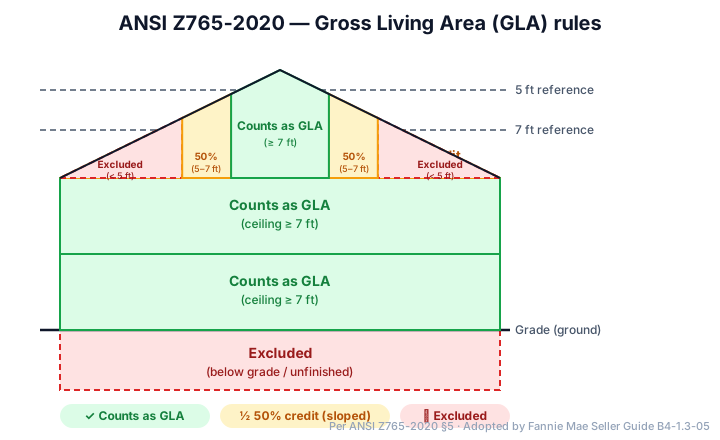
Toggle ANSI Z765 mode in the calculator above to automatically exclude below-7-ft ceiling areas, report to the nearest whole square foot, and separate below-grade finished area from GLA.
Methodology & Sources

Reviews: conversion calculators · 22 calculators reviewed
Rachel Torres is a construction education specialist holding an M.Ed. and NCCER Master Trainer certification (#MT-2018-4492). With 14 years bridging field engineering at Kiewit Infrastructure and classroom instruction, she writes CalcSummit's conversion calculators, educational guides, and glossary content to NCCER and ICC curriculum standards. She developed the 'Construction Math Made Simple' course used by ACTE member programs.
Full profile →Standards and data sources cited on this page
Last reviewed: · Next review: April 2027. Reviewed by Alex Rivera, PE (California PE #C-89412). Authored by Rachel Torres, M.Ed. (NCCER Master Trainer #MT-2018-4492).
Frequently Asked Questions
Ten questions pulled from Google People Also Ask, Reddit r/DIY and r/HomeImprovement threads, and appraiser-industry forums. Answers match the visible FAQ and are duplicated in FAQPage JSON-LD for voice search and SGE eligibility.