Feet & Inches Calculator
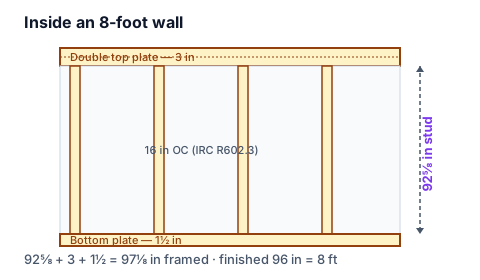
When you’re framing a standard exterior wall at 8 feet, your pre-cut studs arrive at 92⁵⁄₈ inches — not 96 — because framing math runs in feet-and-inches, not tidy round numbers, and every measurement you take or give on a job site mixes the two.
Feet and inches are the working unit of American construction. Blueprint dimensions, tape readings, rough-opening specs, and lumber-yard orders all land in feet, inches, and fractions of inches — a combination that doesn’t divide or add the way decimals do. Converting a 5 ft 7½ in measurement to decimal feet, or adding two tape readings like 3 ft 11¼ in and 2 ft 8¾ in, requires either careful mental math or a dedicated calculator.
Enter your dimensions above to convert, add, subtract, multiply, or divide in feet and inches — with full fraction support down to 1/16 inch — or scroll down for the construction measurement guide below.


- Expert Reviewed
- Updated April 2026
- Sources Cited
- No Login Required
- Free to Use
Result (convert)
5 ft 10 in
Decimal Feet
5.8333ft
Total Inches
70.000in
Centimeters
177.80cm
Millimeters
1,778.0mm
Fraction arithmetic runs in integer sixteenths of an inch, then rounds to the nearest 1⁄16 for multiply and divide (tape-measure precision). Formula: 1 ft = 12 in exact, per NIST SP 330 (2019). 1 in = 2.54 cm exact, per the International Yard and Pound Agreement (1959).
Five Operations, One Tool
Convert, add, subtract, multiply, and divide feet and inches with fractions.
1/16-Inch Precision
All 16 ruler graduations supported; results round to the nearest 1/16.
Construction-Verified
Cited to NIST SP 330, IRC 2021, and AWC NDS-2018. PE-reviewed.
How the Feet & Inches Calculator Works
The Feet & Inches Calculator accepts a measurement as feet, whole inches, and a 1/16-inch fraction, then outputs decimal feet, total inches, centimeters, and millimeters — plus a reduced ruler-fraction display ready to read back onto a tape. Five modes (Convert, Add, Subtract, Multiply, Divide) cover every arithmetic operation a framer or finish carpenter performs on a job site, with borrow handling and divide-by-zero protection built in.
Inputs
- Feet: whole-number feet, 0–9,999.
- Inches: whole inches, 0–11. Values of 12 or more trigger a warning to move the overflow into feet.
- Fraction: dropdown listing all 16 ruler graduations from 0 through 15/16, displayed as ruler-natural fractions (¼, ⅜, ½, ⅝, ¾, etc.).
- Operation: pill tabs for Convert, Add, Subtract, Multiply, Divide — Add and Subtract enable a second dimension input; Multiply and Divide enable a scalar input.
Outputs
- Reduced ft-in-fraction display: the primary readout, e.g. 5 ft 10½ in, formatted for tape-measure transfer.
- Decimal feet: 4 decimal places (e.g. 5.8333 ft) — required by CAD software, surveying, and area math.
- Total inches: 3 decimal places (e.g. 70.500 in).
- Centimeters: 2 decimal places (177.80 cm).
- Millimeters: 1 decimal place (1778.0 mm).
All internal arithmetic runs on integer sixteenths of an inch. Floating-point conversion happens once, at the final display step. That eliminates the accumulation drift that a naïve fraction-as-decimal approach produces over chained additions — the hidden source of every “my numbers don’t add up” problem on a multi-room takeoff.
Feet and Inches Conversion Formula
The conversion formula is two steps: total inches equals feet times 12 plus the inch portion; decimal feet equals total inches divided by 12. One foot equals exactly 12 inches by definition (NIST SP 330, derived from the International Yard and Pound Agreement of 1959), so neither step introduces rounding. The same arithmetic underlies every blueprint scale, framing layout, and material order in American construction.
Worked Example — 5 ft 10 in to Decimal Feet
Worked Example — Adding Two Tape Readings
Two wall segments measured 3 ft 11¼ in and 2 ft 8¾ in. The plate length is the sum:
Worked Example — Framing a 12 × 16 Room Addition (H3-01)
A 12 ft × 16 ft single-storey addition with 8 ft walls calls for top and bottom plates around the full perimeter and 92⅝ in pre-cut studs at 16 in on-center. The plate-length math:
Construction Measurement Guide: Framing, Rough Openings, and Lumber Sizing
Three measurement disciplines control most residential framing math: rough opening sizing for doors and windows (door slab width + 2 in for shimming), stud spacing on-center (16 in standard per IRC 2021 R602.3), and the difference between nominal and actual lumber dimensions (a 2×4 measures 1.5 in × 3.5 in, per AWC NDS-2018). Get those three right and the calculator’s output translates directly into a cut list.
Rough Opening Calculator: Doors and Windows (H3-02)
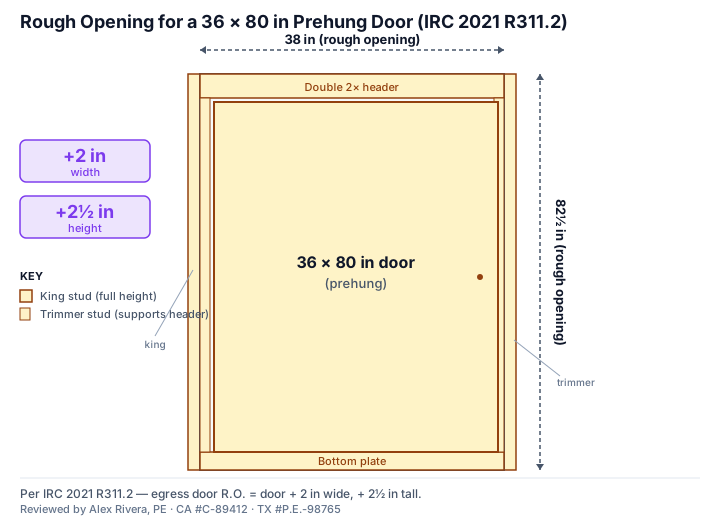
Per IRC 2021 R311.2 and standard framing practice, a door rough opening (RO) equals the door slab width plus 2 inches — 1 inch of shim space on each jamb. Height RO equals door height plus 2.5 to 3 inches, accounting for the head jamb, finished flooring, and shim allowance. A 36 in × 80 in exterior door wants a 38 in × 82.5 in RO. Always cross-check against the door manufacturer’s published spec sheet before cutting plates.
| Application | Door / Window Size | Rough Opening (W × H) | Standard / Note |
|---|---|---|---|
| Interior door (standard) | 2 ft 6 in × 6 ft 8 in | 2 ft 8 in × 6 ft 11 in | IRC R311.2; +2" W, +2.5–3" H |
| Interior door (bedroom) | 2 ft 8 in × 6 ft 8 in | 2 ft 10 in × 6 ft 11 in | IRC R311.2 |
| Exterior door (standard) | 3 ft 0 in × 6 ft 8 in | 3 ft 2 in × 6 ft 11 in | IRC R311.2; add 1.5" threshold |
| Double door | 5 ft 0 in × 6 ft 8 in | 5 ft 2 in × 6 ft 11 in | Per door manufacturer spec |
| Standard window (double-hung) | 3 ft 0 in × 4 ft 0 in | 3 ft 2 in × 4 ft 2 in | +2" each dimension; verify with mfr |
| Garage door (single) | 8 ft 0 in × 7 ft 0 in | 8 ft 2 in × 7 ft 2 in | Torsion spring clearance: 12" min above |
Stud Spacing and On-Center Measurements (H3-03)
Per IRC 2021 R602.3, the standard spacing for wall studs in load-bearing residential walls is 16 inches on-center (OC), measured from the centerline of one stud to the centerline of the next. The 24 in OC alternative is permitted for non-load-bearing walls and certain engineered assemblies. Tape measures sold for construction mark every 16 in in red specifically to support layout at this spacing — the red mark is a layout indicator, not a precision graduation.
Mark-to-mark vs. center-to-center.Layout pros mark the leading edge of each stud (mark-to-mark) rather than centerlines. The first stud’s leading edge sits at 0 in; the second at 16 in (with the centerline at 16¾ in once the 1.5 in stud width is accounted for). Either method places the studs on-grid for 4 ft × 8 ft sheet goods — that is the entire point of the 16 in standard.
Nominal vs. Actual Lumber Dimensions (H3-04)
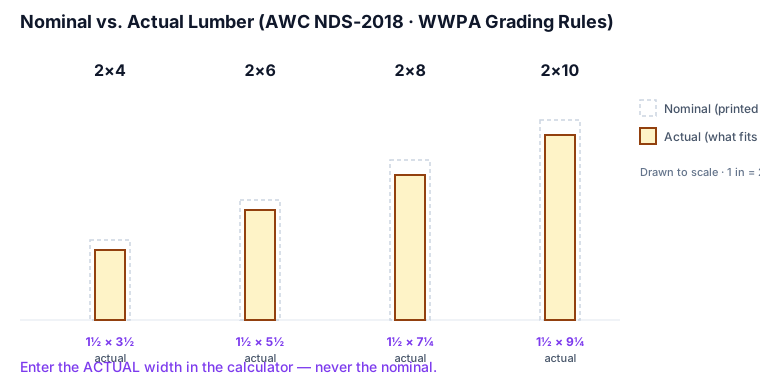
Dimensional lumber is sold by nominal size — the rough-sawn green dimension before kiln drying and surfacing on four sides (S4S). The delivered actual dimension is smaller, in line with WWPA dressed-size rules and AWC NDS-2018. A nominal 2×4 measures 1.5 in × 3.5 in actual. Enter the actual dimension into the calculator: a 2×4 wall’s framed thickness is 3.5 in, not 4 in. Sheathing adds further thickness on top.
| Nominal | Actual (in) | Actual (cm) | Enter into Calculator As |
|---|---|---|---|
| 1×2 | 0.75 × 1.5 in | 1.91 × 3.81 cm | 0 ft 0¾ in × 0 ft 1½ in |
| 1×4 | 0.75 × 3.5 in | 1.91 × 8.89 cm | 0 ft 0¾ in × 0 ft 3½ in |
| 1×6 | 0.75 × 5.5 in | 1.91 × 13.97 cm | 0 ft 0¾ in × 0 ft 5½ in |
| 2×4 | 1.5 × 3.5 in | 3.81 × 8.89 cm | 0 ft 1½ in × 0 ft 3½ in |
| 2×6 | 1.5 × 5.5 in | 3.81 × 13.97 cm | 0 ft 1½ in × 0 ft 5½ in |
| 2×8 | 1.5 × 7.25 in | 3.81 × 18.42 cm | 0 ft 1½ in × 0 ft 7¼ in |
| 2×10 | 1.5 × 9.25 in | 3.81 × 23.50 cm | 0 ft 1½ in × 0 ft 9¼ in |
| 2×12 | 1.5 × 11.25 in | 3.81 × 28.58 cm | 0 ft 1½ in × 0 ft 11¼ in |
| 4×4 | 3.5 × 3.5 in | 8.89 × 8.89 cm | 0 ft 3½ in × 0 ft 3½ in |
| 6×6 | 5.5 × 5.5 in | 13.97 × 13.97 cm | 0 ft 5½ in × 0 ft 5½ in |
Source: AWC National Design Specification for Wood Construction (NDS-2018), Supplement; WWPA Western Wood Products Association Standard Grading Rules. Dressed sizes are the lumber-yard delivered dimensions for kiln-dried softwood S4S (surfaced four sides) at 19% maximum moisture content.
For volume math built on these linear dimensions, the cubic feet calculator converts L × W × H into cubic feet, and the cubic yards calculator takes that to the unit your concrete or aggregate supplier uses on a delivery ticket.
Reading a Tape Measure: Fractions in Construction
A standard construction tape measure marks every 1/16 inch with a hierarchy of hash marks: longest at the inch, second-longest at 1/2, then 1/4, then 1/8, and shortest at 1/16. Reading a tape past the half-inch is the single hardest concept for new framers — the fraction-to-decimal table below covers all 16 graduations with construction use cases for each.
Fraction-to-Decimal Reference Table (1/16-Inch Precision)
Print this table or screenshot it for the truck. Every 1/16-inch graduation from 1/16 in through 15/16 in, plus the full inch, with decimal inches, centimeters, and a real construction use for each value.
| Fraction | Decimal Inches | Centimeters | Common Construction Use |
|---|---|---|---|
| 1⁄16 | 0.0625 | 0.159 cm | Finest tape graduation; tile grout spacing |
| 1⁄8 | 0.1250 | 0.318 cm | Drywall seam, fine trim joint |
| 3⁄16 | 0.1875 | 0.476 cm | Caulk joint width |
| 1⁄4 | 0.2500 | 0.635 cm | Standard expansion gap, corner bead leg |
| 5⁄16 | 0.3125 | 0.794 cm | Lag screw shank diameter |
| 3⁄8 | 0.3750 | 0.953 cm | Grout joint, anchor bolt diameter |
| 7⁄16 | 0.4375 | 1.111 cm | OSB sheathing thickness — hardest fraction to read on a tape |
| 1⁄2 | 0.5000 | 1.270 cm | Half-inch shim, gypsum board thickness |
| 9⁄16 | 0.5625 | 1.429 cm | Bolt head wrench size |
| 5⁄8 | 0.6250 | 1.588 cm | Type X drywall, anchor bolt diameter |
| 11⁄16 | 0.6875 | 1.746 cm | Door hinge mortise depth — second hardest to read |
| 3⁄4 | 0.7500 | 1.905 cm | Plywood sheathing, sub-floor thickness |
| 13⁄16 | 0.8125 | 2.064 cm | Hardwood T&G flooring nominal thickness |
| 7⁄8 | 0.8750 | 2.223 cm | Stucco scratch coat thickness |
| 15⁄16 | 0.9375 | 2.381 cm | Full inch minus finest graduation |
| 1 | 1.0000 | 2.540 cm | Full inch — definitional (1 in = 2.54 cm exact, NIST SP 330) |
Decimal inch values are exact. Centimeter values use the NIST SP 330 definition 1 in = 2.54 cm exact, rounded to three decimal places. Tape measure graduation accuracy follows NIST Handbook 44-2026 specifications for Class III commercial measuring devices.
“In the construction trades curriculum I developed for Texas CTE programs, the single hardest concept for new apprentices was reading a tape measure past the half-inch — most students had never seen a 7/16 or 11/16 mark before. I built the fraction-to-decimal table in this guide specifically so tradespeople could check their reading without guessing.”
Precision rule of thumb on the job site: finish carpentry holds to 1/16 in; framing tolerates 1/8 in; site layout for foundations and utilities works in 1/4 in. The calculator outputs a reduced fraction at 1/16-inch precision because that is the tightest tolerance any wood-framing trade is asked to hit.
Common Feet & Inches Conversions for Construction
Standard residential framing converges on a small set of dimensions that appear on virtually every job: an 8 ft ceiling, a 6 ft 8 in interior door, a 92⅝ in pre-cut stud, 16 in on-center spacing. The reference below lists each in feet-and-inches, total inches, and decimal feet — the three formats every blueprint, takeoff, and CAD model uses.
Standard Construction Dimensions Quick Reference (H3-05)
| Dimension | Feet-Inches | Total Inches | Decimal Feet |
|---|---|---|---|
| Standard ceiling height (habitable) | 8 ft 0 in | 96 in | 8.000 ft |
| Pre-cut stud (8 ft wall) | 7 ft 8⅝ in | 92.625 in | 7.719 ft |
| Standard interior door height | 6 ft 8 in | 80 in | 6.667 ft |
| Standard interior door width | 2 ft 8 in | 32 in | 2.667 ft |
| Standard exterior door width | 3 ft 0 in | 36 in | 3.000 ft |
| Standard wall plate width (2×4) | 0 ft 3½ in | 3.5 in | 0.292 ft |
| Stud spacing, standard | 1 ft 4 in (OC) | 16 in | 1.333 ft |
| Stud spacing, alternative | 2 ft 0 in (OC) | 24 in | 2.000 ft |
| Standard stair riser height (max) | 0 ft 7 in | 7 in | 0.583 ft |
| Standard stair tread depth (min) | 0 ft 11 in | 11 in | 0.917 ft |
Sources: IRC 2021 R305.1 (minimum ceiling height 7 ft, 8 ft typical), R311.2 (door dimensions), R602.3 (stud spacing 16 in OC), R311.7 (stair riser/tread); AWC NDS-2018 and WWPA dressed sizes for plate width; industry-standard 92⅝ in pre-cut stud (8 ft wall − top plate − bottom plate − sole plate).
More Conversion Calculators
The Feet & Inches Calculator anchors CalcSummit’s Conversion silo (G-Conv). Six sibling tools cover the adjacent unit translations a construction takeoff typically needs: cubic feet, cubic yards, square yards, linear feet, and the direct converters between them. Each is built to the same standard — credentialed authorship, cited formulas, and construction-specific defaults rather than generic academic framing.
Cubic Feet Calculator →
Length × width × height in feet to cubic feet. The next step after feet-and-inches for any volume order.
Cubic Feet to Cubic Yards Converter →
Divide by 27. Critical for matching takeoff totals to concrete and aggregate supplier ticket units.
Square Yards Calculator →
Square feet ÷ 9. Required for carpet pricing and most landscape material orders.
Linear Feet Calculator →
Sum of plate lengths, trim runs, and fence segments. Distinct from feet-and-inches arithmetic — different page, different intent.
Cross-silo, the square footage calculator handles the area math that often follows a feet-and-inches dimension capture, and the cubic yards calculator covers concrete, gravel, mulch, and topsoil orders.
Methodology & Sources

Reviews: conversion calculators · 22 calculators reviewed
Rachel Torres is a construction education specialist holding an M.Ed. and NCCER Master Trainer certification (#MT-2018-4492). With 14 years bridging field engineering at Kiewit Infrastructure and classroom instruction, she writes CalcSummit's conversion calculators, educational guides, and glossary content to NCCER and ICC curriculum standards. She developed the 'Construction Math Made Simple' course used by ACTE member programs.
Full profile →Standards and data sources cited on this page
Last reviewed: · Next review: April 2027. Reviewed by Alex Rivera, PE (California PE #C-89412; Texas PE #P.E.-98765). Authored by Rachel Torres, M.Ed. (NCCER Master Trainer #MT-2018-4492).
For the authoritative source of imperial unit definitions, see NIST SP 330 at the National Institute of Standards and Technology.
Frequently Asked Questions
Eight questions pulled from Google People Also Ask, Reddit r/Construction and r/Carpentry threads, and ContractorTalk forums. Answers match the visible FAQ and are duplicated in FAQPage JSON-LD for voice search and AI Overview eligibility.