Contractor Comparison Calculator: Score and Rank Bids Like a CPE
Most homeowners get two bids and pick the lowest number. That's how projects go over budget. A fair contractor comparison requires at least three written bids for identical scope — then a systematic evaluation of nine factors beyond price: materials specification, timeline commitment, warranty terms, licensing status, insurance coverage, payment schedule, change order policy, subcontractor disclosure, and client references. This calculator applies CPE-weighted scoring to each factor and produces a ranked score for every contractor you enter.
START COMPARING- Expert Reviewed
- Updated May 2026
- Sources Cited
- No Login Required
- Free to Use

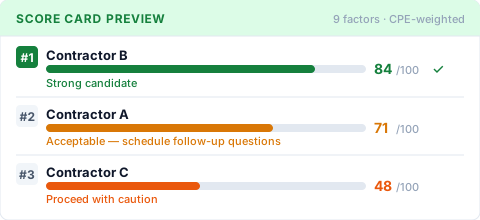
Score and Rank Your Bids
Enter your contractor bids and rate each on nine weighted factors. Scoring updates live as you adjust ratings. All processing happens in your browser — no data leaves this page.
Rate each factor — 1 (poor) to 5 (excellent)
Does the bid define all work explicitly? Missing scope is the leading driver of change-order overruns.
Milestone-tied or time-based? Front-loaded deposits are a cash-flow red flag.
State license number verifiable? $1M+ general liability? Workers' compensation in force?
Written change-order process? Owner approval and pricing agreed before work begins?
Named brands and model numbers, or open allowances? Firm-spec bids are directly comparable.
Written completion date with a penalty (liquidated damages) clause?
Labor warranty minimum 1 year; materials passthrough from manufacturer.
Subs named with license numbers? Unnamed subs are a scope-ambiguity risk.
Three or more verifiable references for similar project type and scale.
Rate each factor — 1 (poor) to 5 (excellent)
Does the bid define all work explicitly? Missing scope is the leading driver of change-order overruns.
Milestone-tied or time-based? Front-loaded deposits are a cash-flow red flag.
State license number verifiable? $1M+ general liability? Workers' compensation in force?
Written change-order process? Owner approval and pricing agreed before work begins?
Named brands and model numbers, or open allowances? Firm-spec bids are directly comparable.
Written completion date with a penalty (liquidated damages) clause?
Labor warranty minimum 1 year; materials passthrough from manufacturer.
Subs named with license numbers? Unnamed subs are a scope-ambiguity risk.
Three or more verifiable references for similar project type and scale.
Rate each factor — 1 (poor) to 5 (excellent)
Does the bid define all work explicitly? Missing scope is the leading driver of change-order overruns.
Milestone-tied or time-based? Front-loaded deposits are a cash-flow red flag.
State license number verifiable? $1M+ general liability? Workers' compensation in force?
Written change-order process? Owner approval and pricing agreed before work begins?
Named brands and model numbers, or open allowances? Firm-spec bids are directly comparable.
Written completion date with a penalty (liquidated damages) clause?
Labor warranty minimum 1 year; materials passthrough from manufacturer.
Subs named with license numbers? Unnamed subs are a scope-ambiguity risk.
Three or more verifiable references for similar project type and scale.
Your Ranked Comparison
Enter a bid amount for at least two contractors and rate at least three factors on each to generate a meaningful comparison.
Section 01
What Does a Contractor Comparison Calculator Do?
A contractor comparison calculator — sometimes shortened to contractor calculatorin homeowner forums — ranks two to five contractor bids on price plus nine weighted quality factors, producing a single 0-to-100 score for each bid. It replaces the gut-feel “pick the cheapest” decision with a documented, repeatable evaluation a general contractor would not be able to dispute. The calculator separates the GC's price from the scope of work it covers, then weights nine quality factors — scope, payment schedule, license and insurance, change-order policy, materials, timeline, warranty, subcontractor disclosure, and references — to expose bids that look cheap but carry hidden risk. Use the contractor calculator for any project where you need a written audit trail for your selection.
Section 02
How Many Contractor Bids Should You Get?
Get at least three written bids for any project over $5,000, and four to five bids for projects over $50,000 or involving specialty trades. Three bids is the minimum needed to detect outliers — one bid gives you no benchmark, two bids cannot reveal which is the outlier, and three bids let you spot the bid that is more than 25% above or below the median. For projects above $50,000, a fourth bid protects you against bid shopping by a GC who might solicit homeowner-collected bids to pressure their own subs.
Two structural rules constrain the bid pool. First, every contractor must bid the same scope; otherwise the comparison is meaningless. Second, every contractor must receive identical specification documents on the same day. RS Means 2026 bidding guidance treats a bid set as invalid when one bidder has 48 hours more lead time than another. Solo bids in the $5,000-to-$15,000 range often have wider spreads simply because small jobs absorb a contractor's fixed cost differently — three bids still apply, but expect ±15% variance rather than ±10%.
Section 03
How to Compare Contractor Bids Fairly (Bid Leveling)
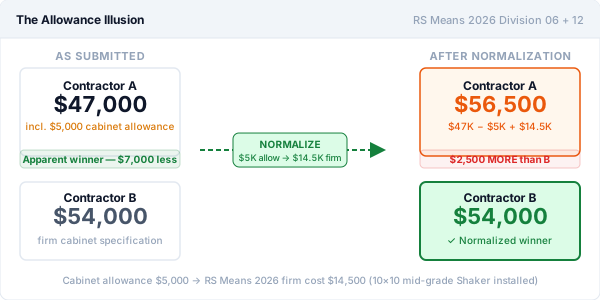
Fair bid comparison starts with bid leveling, the process of normalizing every bid to identical scope before comparing totals. Two bids of $47,000 and $52,000 may look like a $5,000 spread, but if the cheaper bid uses a $5,000 cabinet allowance and the more expensive bid quotes a firm $14,500 cabinet line, the cheaper bid is actually $4,500 more once normalized. Bid leveling exposes that gap.
The five-step bid leveling process:
- Build a line-item worksheet. Map every bid onto the same row set: demolition, materials, labor, subcontractors, permits, overhead and profit, allowances, warranty, timeline, license and insurance.
- Identify every allowance. Highlight any placeholder dollar amount labeled as an allowance (cabinet allowance, tile allowance, fixture allowance).
- Convert each allowance to a firm cost. Either obtain firm subcontractor quotes or use RS Means 2026 unit costs for the mid-grade specification.
- Replace allowance amounts with firm costs in each bid. The allowance disappears; a firm line item replaces it at the cost equivalent across all bids.
- Recalculate the normalized total. Compare normalized totals — not the original bid totals.
Use the calculator's bid amount field for the normalized total, not the bid as submitted. The goal is an apples-to-apples comparison — every bid priced on the same specification before you score a single quality factor.
| Line Item | Contractor A | Contractor B | Contractor C | Normalization Note |
|---|---|---|---|---|
| Demolition & disposal | $— | $— | $— | Confirm dump fees included |
| Materials (firm-specified) | $— | $— | $— | Replace allowances with RS Means 2026 unit cost |
| Labor | $— | $— | $— | Verify crew size and hours |
| Subcontractors | $— | $— | $— | Named subs only; no TBD |
| Permits & inspections | $— | $— | $— | Confirm all permits included |
| GC overhead + profit | $— | $— | $— | Benchmark: 18-25% residential |
| Warranty allowance | $— | $— | $— | 1-year labor min; note longer terms |
| Allowances (before normalization) | $— | $— | $— | Highlight every allowance line |
| Allowance → firm cost replacement | $— | $— | $— | RS Means 2026 or matched sub quote |
| Normalized total | $— | $— | $— | Use this figure in the calculator |
Section 04
The 9 Calculator Factors Explained
The calculator scores each contractor on nine factors. Four factors carry 72% of the total quality weight — scope, payment, license, and change-order policy — because CPE field data shows these four factors account for the largest share of dispute risk and budget overrun. Rate each factor 1 (poor) to 5 (excellent) using the anchor definitions below.
Factor 1: Scope Clarity (Weight 25%)
Scope clarity measures whether the bid defines every task with materials and quantities. A 5 means each line item is itemized — for example, “install 32 LF of 5/8″ Type X drywall on ceiling, level 5 finish.” A 1 is a single lump sum with no breakdown. Missing scope is the leading driver of change-order overruns.
Factor 2: Materials Specification (Weight 10%)
Materials specificationmeasures whether the bid names brands and model numbers rather than open allowances. A 5 reads “Kohler Elmbrook K-3998 toilet, white”; a 1 reads “$200 toilet allowance.”
Factor 3: Timeline Commitment (Weight 8%)
Timeline commitmentmeasures whether the bid contains a written completion date with a liquidated damages clause. A 5 reads “substantial completion by August 15, 2026, $250 per day liquidated damages thereafter.” A 1 reads “approximately 6-8 weeks.”
Factor 4: Warranty Terms (Weight 4%)
Warranty terms measure labor and materials coverage. Industry minimum labor warranty is 1 year (statutory in most US states); manufacturer materials warranty should pass through directly. A 5 means two-plus years labor plus full materials passthrough.
Factor 5: License + Insurance (Weight 15%)
License and insuranceis a near-binary factor. A 5 means state license number verified against the contractor board, $1M+ general liability certificate provided, and current workers' compensation. A 1 means no license number on the bid. Any contractor scoring 1 on this factor triggers a “Review carefully” badge — license adequacy is non-negotiable.
Factor 6: Payment Schedule (Weight 20%)
Payment schedule measures the cash-flow risk profile of the bid. A 5 is milestone-tied with a 10% deposit and 10% retainage held until punch-list completion — the structure AIA A101 §5 codifies. A 1 demands more than 33% upfront.
Factor 7: Change Order Policy (Weight 12%)
Change order policymeasures whether the bid commits to a written CO process. A 5 means written CO policy, owner approval required before work begins, and unit prices for likely changes agreed upfront. Sarah Kim's field data shows projects with written CO policies see 68% fewer dispute escalations.
Factor 8: Subcontractor Disclosure (Weight 3%)
Subcontractor disclosure measures whether the bid names every sub and includes license numbers. AIA A201 §5.2 establishes the General Conditions: subs hired after bid acceptance can shift the actual qualifications of the trade work.
Factor 9: Client References (Weight 3%)
Client references measure verifiability of comparable past work. A 5 means three-plus references for similar projects plus portfolio photos. Verify references by phone — emailed testimonials are easier to fabricate than a five-minute conversation about the project.
Section 05
What Is a Fair GC Markup? (2026 Benchmarks)
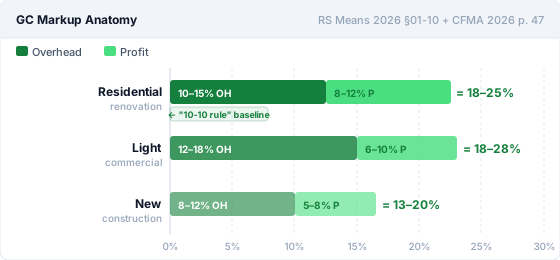
A fair GC markupruns 18% to 25% above direct project costs for residential renovation work — 10% to 15% covering general overhead and 8% to 12% covering profit. The construction industry's “10-10 rule” — 10% overhead plus 10% profit — is the practical baseline that RS Means 2026 §01-10 documents for well-managed residential GCs. Light commercial work runs higher (12-18% overhead, 6-10% profit); new construction tightens because volume amortizes overhead.
The markup percentage is not arbitrary padding. Overhead pays the GC's office rent, insurance premiums, vehicles, and unbillable labor on bid preparation. Profit is what funds the GC's capital reserves for warranty callbacks, equipment replacement, and dispute defense. A bid with a markup well below 18% should raise the same question as a bid 25%+ above the median: where is the cost going to surface? The CFMA Benchmarks 2026 (p. 47) reports net profit margins of 5% to 7% for well-managed residential GCs — the rest of the markup absorbs overhead.
| Project Category | Overhead % | Profit % | Total Markup | Source |
|---|---|---|---|---|
| Residential renovation | 10-15% | 8-12% | 18-25% | RS Means 2026 §01-10 |
| Light commercial | 12-18% | 6-10% | 18-28% | CFMA 2026 p. 47 |
| New construction residential | 8-12% | 5-8% | 13-20% | RS Means 2026 §01-10 |
| Specialty trades (sub-prime) | 8-12% | 10-15% | 18-25% | CFMA 2026 + RS Means 2026 |
Section 06
Change Order Risk: What to Expect by Project Type
Change orders are the leading driver of construction budget overruns, and the change-order risk varies by an order of magnitude across project types. A fence replacement runs a 1-to-3% CO rate; an addition runs 10-to-20%. The difference is scope ambiguity: a fence is a defined object, an addition involves opening existing walls and finding whatever the original builder did. Budget a contingency reserve for scope creep in proportion to the unknowns under the surface — 5% for lower-risk project types, 12-15% for gut-renovation or addition work.
| Project Type | Typical CO Rate | Expected Overrun | Mitigation Tip |
|---|---|---|---|
| Kitchen remodel | 8-15% | $3,000-$15,000 | Demo before pricing finishes; cabinet allowance kills budgets |
| Bathroom remodel | 10-15% | $2,500-$10,000 | Plumbing surprises behind walls; budget 12% contingency |
| Deck build | 3-6% | $500-$3,000 | Soil and post-footing depth are the variables |
| Fence replacement | 1-3% | $200-$800 | Lowest CO risk; firm-bid every line item |
| Addition | 10-20% | $8,000-$50,000+ | Highest CO risk; structural and code surprises common |
| Roofing | 3-7% | $800-$4,000 | Deck damage hidden until tear-off |
| Flooring | 2-5% | $400-$2,500 | Subfloor leveling is the typical CO trigger |
| HVAC | 5-10% | $1,500-$6,000 | Ductwork modifications drive most overruns |
Section 07
Lump-Sum vs. Cost-Plus: Which Contract Is Better?
The choice between a firm bid vs. allowance bid is also a contract-type decision. A lump-sum contract fixes the price; a cost-plus contract reimburses the contractor for actual costs plus a markup. Lump-sum is better when the scope is fully defined; cost-plus is better when scope must remain flexible. For most residential renovation, lump-sum is the right contract because the work is defined and the owner needs price certainty.
The middle ground is lump-sum with allowances. Specified items are firm-priced; uncertain items (cabinets, tile, fixtures) carry a documented allowance with a procedure for converting to firm cost. If you are leaning cost-plus on a residential project, require a guaranteed maximum price (GMP) cap; without it, the cost-plus model has no ceiling.
Section 08
Allowance Normalization: The $5,000 Cabinet Example
An allowanceis a placeholder dollar amount in the bid for an unspecified item — “cabinet allowance: $5,000” — that gets reconciled against the actual cost when the owner selects the product. Allowances are not lies, but they make bids look cheaper than they will turn out to be.
Worked example.Contractor A bids $47,000 including a $5,000 cabinet allowance. Contractor B bids $54,000 with a firm specification of mid-grade Shaker cabinets at $14,500 installed. The bids look like a $7,000 spread in Contractor A's favor. Normalize: replace Contractor A's $5,000 allowance with the same firm specification used in Contractor B's bid. RS Means 2026 Division 06 + 12 unit costs price mid-grade Shaker kitchen cabinets at $14,500 for a 10×10 kitchen. Contractor A's normalized bid is $47,000 − $5,000 + $14,500 = $56,500. Contractor A is now $2,500 higher than Contractor B for the same cabinets. The cheap bid was the optical illusion.
Section 09
8 Contractor Bid Red Flags
Eight specific patterns recur across the contractor disputes that reach mediation. Proper contractor vetting before signing is the single highest-ROI step in the bidding process. Watch for any of these red flags; two or more in the same bid is a near-automatic disqualifier.
- Deposit demand above 33% of contract value. State norms run 10% to 15% for projects over $10,000; AIA A101 conventions cap reasonable deposits at one-third.
- No state license number on the bid. Every state with contractor licensing requires the number on bids and contracts.
- All-allowance materials specification.A bid where every material line reads “allowance” gives the contractor unilateral cost control after you sign.
- Cash-only payment. Cash bids signal an unlicensed or uninsured operator and eliminate your dispute recourse.
- No written warranty. The 1-year labor warranty is statutory in most states.
- Refusal to pull permits. When a contractor proposes that you, the homeowner, pull permits, the contractor is shifting code-compliance liability to you.
- No preliminary lien notice procedure.A bid that omits the preliminary lien notice procedure leaves you exposed to subcontractor mechanic's liens.
- Pressure to sign within 24 hours. Legitimate bids hold for 30 days.
Section 10
What Should a Contractor Quote Include?
A complete contractor quote contains 12 elements. Missing any single element is grounds for requesting a revised bid before scoring.
- Scope narrative — a paragraph in plain language, distinct from the line items.
- Line-item pricing — every task with quantity, unit, and unit price.
- Materials specification — brand, model, and grade for every product.
- Timeline — start, substantial completion, and final completion dates.
- Warranty terms — labor warranty period and materials passthrough.
- License number — state contractor license number, expiration, classification.
- Insurance certificates — general liability and workers' compensation COIs.
- Payment schedule — deposit, milestone payments, retainage at punch list.
- Change order policy — written CO process.
- Subcontractor disclosure — subs named with license numbers.
- References — three or more for similar projects.
- Exclusions — explicit list of work not included.
Run the revised bid through the contractor calculator at the top of the page to score it against the others.
Section 11
FAQ: 8 Questions Answered by a CPE
Section 12
Glossary of Contractor Bid Terms
- General Contractor
- A company or individual who manages an entire construction project, hiring and coordinating subcontractors. The GC is responsible for overall scope, timeline, and quality; distinct from trade subcontractors they hire.
- Bid Leveling
- The process of adjusting multiple bids to identical scope so they can be compared on equal terms. Also called bid normalization.
- Allowance
- A placeholder dollar amount in a contractor bid for an item not yet specified. Reconciled against actual cost once the product is selected.
- Change Order
- A written authorization to modify the original scope or price of a contract after signing. Change orders are the leading driver of construction budget overruns.
- Retainage
- The portion of each payment — typically 5% to 10% per AIA A201 §9.3 — withheld until the contractor completes the punch list.
- Lump-Sum Contract
- A construction contract where the contractor agrees to a fixed price for a defined scope.
- Cost-Plus Contract
- A construction contract where the owner reimburses the contractor for actual costs plus an agreed markup percentage.
- Preliminary Lien Notice
- A document a subcontractor or supplier files to preserve their right to file a mechanic's lien if not paid by the general contractor.
- Subcontractor
- A specialty trade contractor (electrician, plumber, framer, drywall installer) who works under a general contractor.
- Scope of Work
- The written specification of all work included in a contract, with explicit exclusions.
- Bid Bond
- A surety bond posted by a contractor to guarantee the contractor will enter into the contract at the bid price if awarded.
- Performance Bond
- A surety bond that guarantees the contractor will complete the work to contract specification.
Industry Standards & Sources

Reviews: cost calculators · 24 calculators reviewed
Sarah Kim is a Certified Professional Estimator (CPE) with 15 years of construction cost estimation experience. She holds CPE certification from ASPE (member #20-4891). At Turner Construction, she managed material cost analysis on commercial projects ranging from $2M to $45M. At CalcSummit, she writes and verifies all cost estimation and interior finish calculators, updating regional cost benchmarks quarterly using RS Means-informed data.
Full profile →